
Thinking Machines Lab has released its first model, and the notable thing is not how good it is — it is who gets to have it.
The model, called Inkling, went out on July 15 with open weights under the permissive Apache 2.0 license, published alongside a full technical model card on Hugging Face.1 Anyone can download it, run it, and fine-tune it. At 975 billion parameters, it is a genuinely large model to put out under so permissive a license.
Inkling is a Mixture-of-Experts system — 975 billion total parameters, but only about 41 billion active for any given token, routed through 6 of 256 experts.2 It is natively multimodal, taking text, image, and audio as input, and supports context windows the company says reach up to a million tokens. A smaller companion, Inkling-Small, ships in preview at 276 billion parameters. The weights are posted in two numeric formats, and the lab lists recipes for running the model locally through open-source tools as well as through commercial inference providers.2
What the company doesn't claim is as telling as what it does. In its own announcement, Thinking Machines writes that Inkling "is not the strongest overall model available today," pitching it instead on a "combination of qualities" — multimodality and controllable reasoning.3 The benchmark tables on the release page are the lab's own, with no independent testing cited.
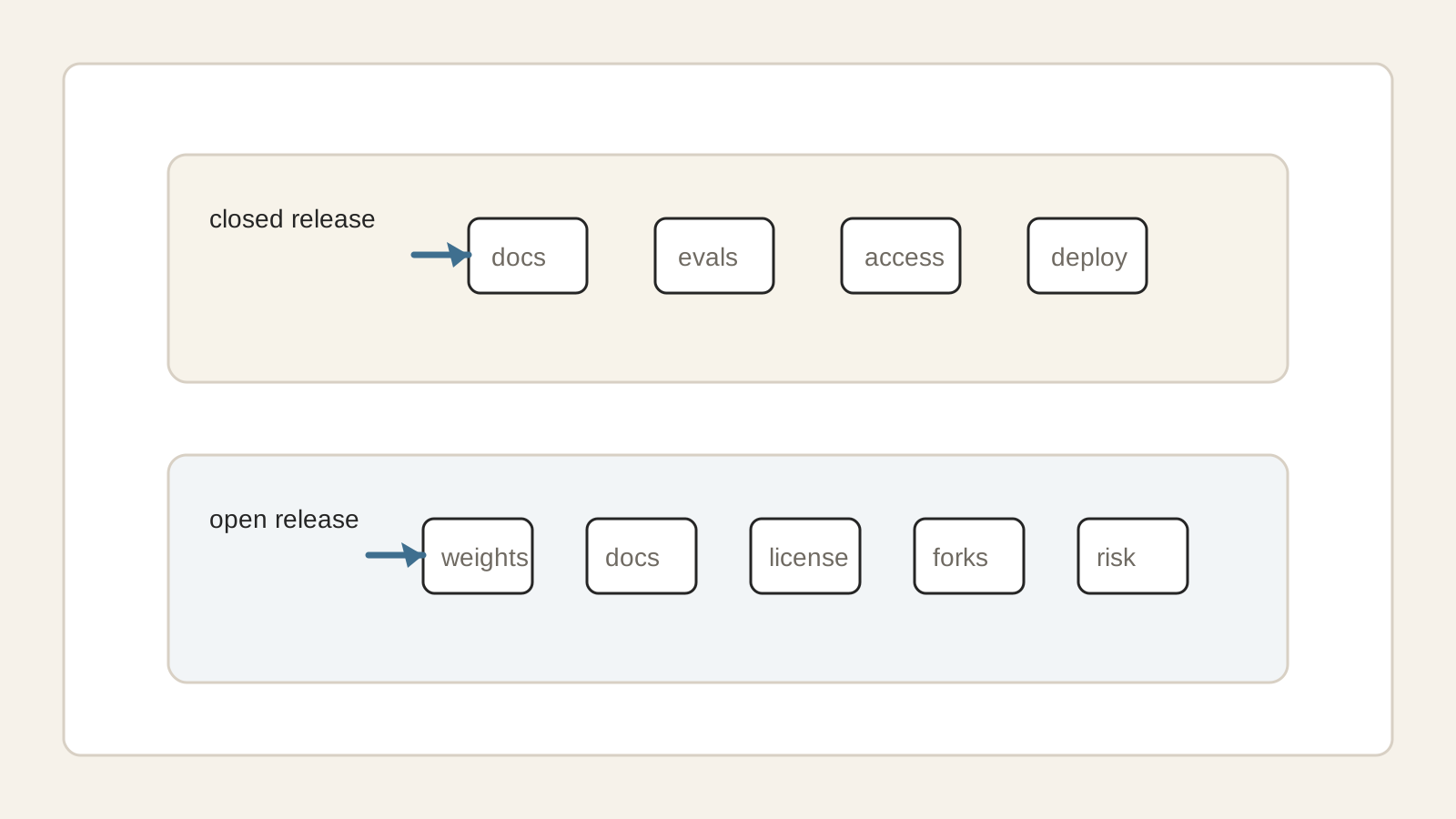
Why it matters. The center of gravity in AI has been closed models served through an API, where the vendor controls the weights, the price, and the terms. A frontier-scale model released under Apache 2.0 pushes the other way: developers can hold the weights themselves, run them on their own hardware, and adapt them without asking permission. That is the open-versus-closed fight, and Inkling is a heavy entry on the open side.
What to watch. "Open" is not the same as "cheap." Running a 975-billion-parameter model is expensive, so the practical audience is developers and companies with real compute, not hobbyists. The Apache license is genuinely permissive, but the lab also attaches an acceptable-use policy, and the performance claims remain unverified until outside researchers test them. The weights are out; whether Inkling is actually worth running is now a question the rest of the field gets to answer.